Our Epic Summer
We thought we’d send you a little summary of what we’ve been
up to for the past six weeks. It has been a whirlwind of a summer (well, winter
in Cape Town), and while we are totally and completely worn out and have very
little desire to go back to East Africa any time soon (until we have a bigger
budget!), we had an amazing time. We felt so privileged to experience some of
the things we did, and want to share them with you.
Here was our general itinerary:
1.
Midwest visit: Minneapolis and Ann Arbor
2.
Greece: Santorini (Fira), Crete (Heraklios and
Chania) and Athens
3.
Uganda: Lake Bunyonyi and Kisoro for gorilla
tracking
4.
Rwanda: Kigali and Nyungwe National Forest
5.
Tanzania: Mwanza, Serengeti National Park,
Ngorongoro Crater, Arusha, Mt. Meru, Dar es Salaam
Midwest Visit
We started the summer travels off with a visit home to the
Midwest. First, Jennifer went to Minneapolis for some quality time at the lake
with Mom & Dad, seeing sister Steph and boyfriend Paul’s new house (which
they own!), and lots of dear friends, including a new baby and new puppy, and
Jim followed a week later when school let out at ASICT. We enjoyed catching up with everyone there,
and got to revisit our old haunts. Jennifer cried when she drove past our old
apartment – we so loved living in Minneapolis and miss our friends and family
dearly.
Then we went on to Ann Arbor where we saw Jim’s family,
including his sister Cassie who made the trip up from Chicago, and his newly
engaged sister Jane who is on the cusp of a big move to San Francisco. Keep
Bill and Betsy in your thoughts as they are about to be empty-nesters. We
enjoyed a backyard party at the Petoskey’s, complete with a keg of Bell’s
Oberon (a fantastic Michigan brew), an eventful trip down the Huron River in a
canoe (which we tipped as we started down some rapids!! Jim had a foot injury
for the first few weeks of the trip—the Mediterranean salt helped to clear up
the infection that gathered after being locked in hiking boots for 12 hours on
the plane). We also got to see dear
friends Jan & Mike and Jon & Caroline, each with respective new homes
who each hosted a get-together in our honor. Jim is now in the process of
convincing Jon and friend Michael to visit him in South Africa in October.
Greece
We left Ann Arbor on June 26th, and flew to
Athens to meet our friends Adam & Lindsey and Adam’s parents Diane and
Grier for a beautiful 10 days in Greece. Jim and I landed in hot Athens, lugged
our backpacks onto the metro, and walked through the streets in our hiking
boots, positively sweating, to find our hostel room’s AC didn’t work! But we
had great souvlaki (kebab) for dinner along with Alfa beers, and walked the
pedestrian streets around the Acropolis (the center of ancient Athens) in a
beautiful Friday night twilight filled with street musicians, kids playing
soccer, couples walking arm-in-arm, and the lights on the Acropolis shining
dramatically above us.
The next day, we took a ferry to Santorini and started in on
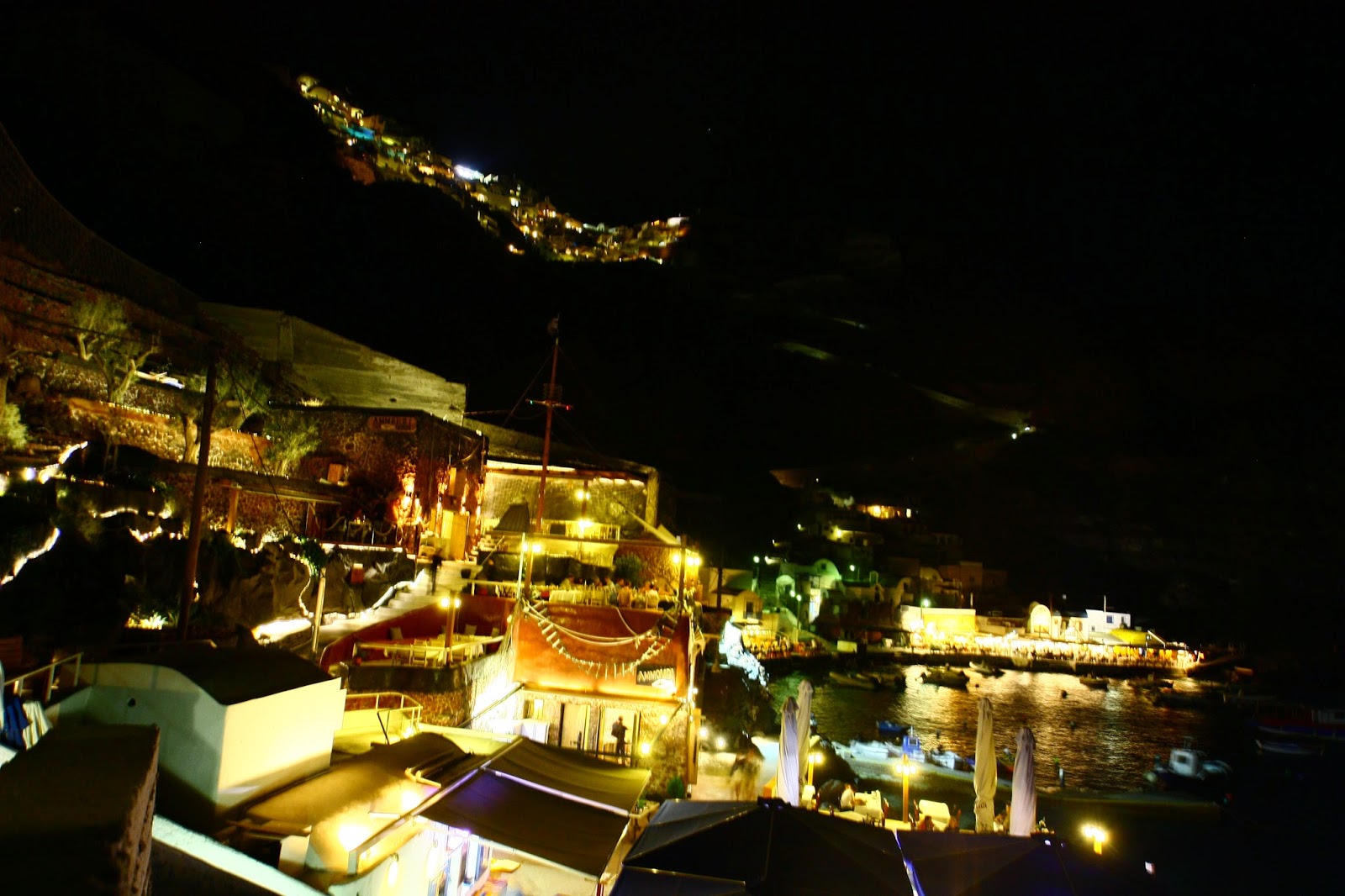
some aggressive sun-bathing and beach-going. Santorini is a volcanic island that
erupted around 1700 BC, eliminating most of its population as well as much of
the population of Crete, an hour by ferry to the south, where an enormous
tsunami engulfed most of the coastal towns—almost every town is coastal on
Crete. Today, the volcano’s caldera is filled with Mediterranean sea, and the
dramatic cliffs left from the eruption make for a stunning viewpoint. The
Davis’ had a beautiful hotel and pool which we got to share for three days with
views out over the caldera. We also explored local beaches, including one with
a nude beach down the way, where we played volleyball with some professional
soccer players from Italy. Lindsey and Jennifer especially enjoyed their
volleyball attire and rippling abdominal muscles. Their girlfriends were pretty nice too. We
also got to enjoy the tradition of drinking raki before and after every meal at
a beautiful little mountainside restaurant called something like Myxonos, where
we had the most amazing lamb in yoghurt sauce served with bulgar wheat. They
mix the raki with honey and cinnamon and heat it up for an after-dinner treat –
absolutely delicious. Even Diane and Greer, who don’t drink, enjoyed it.
From Santorini, we went on to Crete where we saw the ruins
of an ancient Minoan palace (~2300-1400 BC) and then went on to a beautiful
little town called Chania, which had been occupied by Venetians who left their
mark with an old walled city that looked like Italy. The whole group especially
enjoyed a day trip to the southern side of Crete – a stunning 2-hour drive
through a mountain pass, then we arrived in a tiny quiet town with about 8
restaurants and not much else, situated on a secluded beach with cliffs all
around. We hiked to some Roman ruins called Lissos, where we found almost no people
and the clearest water ever. Jim was in heaven with his swim goggles after
walking through ancient tombs and a church that dated to Byzantium—a period he
studied in his only art history class.
We found a water taxi there—Jim had to run to the water ½ an hour ahead
of the crew to ask for a ride—to take us back to the town.
From Chania, Adam, Lindsey, Jim and I flew back to Athens to
mentally prepare ourselves for our return to Africa J We visited the Acropolis and
the museum, and spent a night frolicking in the city before heading to the
airport. After many drinks at dinner the waiter felt compelled to give us
directions to our hotel, which only required one right turn.
Uganda
We landed in Kigali, Rwanda around midnight on July 7 and
got off the plane to the smell of cooking fires in the dusky night. We were
picked up by Adam’s old friend and our new tour guide, Emmanuel and his driver,
Emmanuel. Both men went by Emma, which got a little confusing. We visited the
genocide museum in Kigali the next morning before driving to Uganda, about
three hours on winding roads past miles and miles of subsistence farms terraced
up enormous hillsides.
In Uganda, we spent two days at Lake Bunyonyi, a beautiful
quiet spot with terraced subsistence farms on every hillside and little kids
being canoed to school each morning singing songs. We took the dugout canoes
out for a spin one day, and Jim and I reminisced about our wonderful Boundary
Waters trips. Canoeing isn’t that different wherever you go! (Jennifer wasn’t
steering the boat!! A tree trunk is
different from a hulled-canoe in more ways than one.)
From the lake, we went on to Kisoro, a small town near the
Rwandan border with three great volcanoes on its horizon, and a famous hotel in
its center – the Traveller’s Rest, where Diane Fossey and other
gorilla-studying pioneers came to stay during their explorations. We went
gorilla tracking from Kisoro – mountain gorillas live in a few national parks
in Uganda, Rwanda and the Congo, and some groups have been habituated by
trackers, so you can pay for a license for a day and literally walk up amongst
a group of gorillas and hang out with them (with a park ranger, a group of
trackers, and 7 other tourists assigned to your group). It was a magical day
that started with a long hike across fields and into a rainforest, up hills and
through underbrush, until we suddenly popped out of a bush and a gorilla was
sitting about ten feet away, looking around at the trackers who had led us
there. We were flabbergasted. The brush made it tough to keep track of where
all the gorillas were, but we stayed in their midst and watched one pop out,
then another, and watched them climb trees and beat their chests and eat leaves
and stand and look at us for an hour. We got lucky – we were assigned to find
one family group, and they happened to be across a narrow ravine from another
group. So not only we were close to about 10 gorillas, but we could turn around
and watch another large group eat and climb and play as well. When we left the
gorillas, we all agreed it had been a surreal experience. You can watch some videos of the gorillas by
following links to Jim’s youtube channel here:
https://www.youtube.com/channel/UCINFOjy1tO2X7zfKMjNnazA
One aspect of gorilla watching that surprised us was the
relative tranquility of the gorilla groups.
Despite two neighboring groups meeting, in relative competition with one
another, there was absolutely no violence.
It struck me because of the anger I felt rising towards one of our human
group members in particular, pushing to be in the front and not letting others
have a turn, that humans are so much more violent then these creatures. It was a reminder that humans are the most
dangerous things in our lives, not gorillas, spiders, lions, or whatever other
wildlife you could imagine. This
realization instigated a feeling of reverence for the gorillas that I had not
felt before—huge vegetarians that live in relative peace despite some
occasional male-male aggression that is almost never fatal.
The day after our gorilla trek, we climbed one of those big
volcanoes, Mhuravura, at 4,127 meters high.
The trek begins at 2400 m, which equates to a climb of just under one
vertical mile. Jim and I pushed through some tough steep climbing and a little
altitude funkiness to reach the summit in about 5 hours, and spent three hours
returning. Jim was struggling a little more than Jennifer with the altitude and
steepness of the trail and at one point our guide Emmanuel felt compelled to
ask, “Why is Jennifer stronger, Jim?
Does she work out more than you?” We enjoyed stepping across the border
to Rwanda at the summit. Although the
top was cloudy when we reached it, we enjoyed seeing the variety of plant life
at various altitudes, and got some beautiful views of the neighboring volcanoes
on the descent. We also were followed by a large group of cute kids on our way
back to the car, who shouted “Mzungu! Mzungu! Hi how are you! Give me money!”
at us (most kids in Uganda did this – apparently there is a long tradition of
white people – mzungu – throwing money out of car windows for children).
Rwanda
Adam and Lindsey had to say goodbye the next morning. Adam
is still in Kisoro, volunteering his time in the government hospital there
helping the physicians (he’s just received his doctorate in nursing and will
work as a primary care provider when he returns to Seattle next month). We’ve
heard a few updates from him since, and it has been an intense time – people
around Kisoro have a lot of obstacles to receiving health care, and many of
people go to the hospital only when the situation is so dire that it is really
beyond help. The hospital doesn’t have a cafeteria, so a family member usually
has to come with the sick person to help keep them clean and provide food for
them – a huge burden on families in the area who are generally subsistence
farmers with a big group of kids at home (the average is 8 kids per household).
Keep Adam in your thoughts for us!
Jim, Lindsey and I went on to Kigali, where we left Lindsey
at an airport under construction, sitting in an outdoor waiting area (where
we’d be a few days later), and Jim and I continued on for a harrowing six-hour
drive across southern Rwanda to Nyungwe National Forest. This part of the trip
took a distinctly sour turn. We had kept on the two Emmas as our driver &
guide combo, but neither had spent much time in Rwanda or been to this area
before. We didn’t arrive to our lodging til 9:30 at night, which meant about 3
hours of driving in the dark on a winding road up and down a mountain – kind of
scary in East Africa. But we were safe, and had luckily brought our camp stove
and some Ramen noodles to cook some food for ourselves when we arrived. We were
disappointed in a few things at this park – the cost of activities in the park
was prohibitively high, the lodging (really the only option) was pretty poor,
and there wasn’t much else to do or see. We did enjoy a morning chimpanzee
trek, where we got to sit and watch a dominant male chimpanzee eat his morning
meal of fruits about 50 feet up in a large tree. He would spend about ten
minutes filling his mouth with fruit, then sit back and spend another ten minutes
mashing the fruit in his mouth to get all the juices out. Every so often, a
really disgusting-looking pile of pulp would pop out between his lips. He was
an ugly creature in some ways, but every so often his eyes would sort of look
up at the sky and shine a bright brown, and you could imagine humanity in them
(we share about 99% of our DNA with chimpanzees, fun fact). We laughed at one
point when I was squatting on the group, resting with my knees tucked up near
my chin, and looked up to see him sitting the same way on his tree branch.
We chased a few other chimps on the ground through the
underbrush, which was pretty fun, but only caught glimpses of them. The chimps
are skittish on the ground, but very comfortable in trees. They move around a
lot during the day to find new places to eat. We were lucky to spend so long
with the one male.
We also enjoyed a hike through the rainforest down to a
creek basin where we saw some amazing mahogany trees, as well as the most stunning tree canopy. We’ll
share pictures. On that hike we were lucky to spot a group of Blue Monkeys in a
tree across a ravine from our path, and got to sit and watch them climb and
jump and feed for about half an hour. I also spotted a small, bright
green-and-black snake, a bush viper.
Tanzania
We were ready to leave Rwanda by day 4, and were excited to
part ways with our driver and guide combo, with whom we had started to have the
sorts of disagreements about money that crop up when your trust in one another
starts to erode. We had already chickened out on a bus ride from the border of
Rwanda to Mwanza, Tanzania, and instead had booked ourselves a flight from
Kigali. So we rode back to Kigali with the guys and spent a delightful night
eating dinner at an amazing Indian restaurant there filled with Americans –
expats working at non-profits as well as tourists.
The next morning, we woke up at 4:30am to get to the airport
to board a tiny plane with a family from Mexico City. We all enjoyed
commiserating about the fearfully small plane, the slow climb in elevation, and
finally the beautiful views of Lake Victoria as we came into Mwanza. Jim and I
were glad to enter Tanzania. We enjoyed our day in Mwanza – definitely not a
tourist town, but it was friendly and laid-back enough despite being Tanzania’s
second-largest city. We had Indian again – a very different experience there,
as we were the only customers for most of the night. Indian television was
playing on the TV at full volume, and the three waitresses, the cook and a
manager of sorts all sat around watching it, so we did too (even though it
wasn’t in English). The food was good again, and we enjoyed a good nights’
sleep in our hotel room (as well as the chance to wash our clothes!!) We were
successfully picked up by our next tour guide and driver combo, this time
Mosses and Emily, the next morning – a huge success, as we had found them
online, read some good reviews, wired over the money and been crossing our
fingers for months. They took us into the Serengeti National Park that afternoon,
where we immediately saw wildebeest, zebra, warthog, giraffe, buffalos, and to
top it off, a large pride of lions with adorable cubs of varying ages. We had a
good experience that night sleeping in a little hotel in the muddy village just
outside the park gate, and eating at a “Mama’s” restaurant with our driver
Emily. We had the same meal most nights in the Serengeti – fried chicken or
fish served with a red curry sauce over rice and chips (fried potatoes) with
some cooked green spinach. It was pretty good!
We spent the next three days in the Serengeti. Highlights
included a long day driving up to the very Northern edge of the park, across
the Mara river, to see a huge group of the wildebeest and zebra migration. It was pretty amazing to drive through that
section of the park and see miles upon miles of ground spotted with groups of
wildebeest, and then suddenly come upon a thick group of them together in a
giant field. Their call, a lowing noise that sounds like “gnu” (their other
name), echoed across the plain in the wind, we could see Kenya in the hills in
the distance, and we were the only car out there – it was a really special
experience.
The migration experience only slightly decreased in its
excellence about an hour later when traveler’s diarrhea hit Jennifer suddenly,
requiring her to jump out of the car and relieve herself behind it in the midst
of a wildebeest stampede. Don’t worry – they weren’t running directly past the
car, just about 50 feet away. Also a very “special” experience.
Other highlights of the Serengeti: we camped for two nights
in a public campsite, which we discovered has no fences! Hyenas came into the
camp the first night – we spotted their red eyes reflecting across a field with
our headlamps as we brushed our teeth. We forwent bathroom trips and jumped in
the tent pretty quick! They proceeded to raid the campsite’s trash bins
throughout the night. The next morning, we heard a female lion calling
somewhere nearby, and heard that about 5 lions had been spotted on the road
into the campsite. Later, our guide
told us that a few years earlier a pride of lions killed a buffalo in front of
the camp bathrooms—the screams of the buffalo and growls of the lions lasted
hours into the night while campers huddled, fearing for their lives, in tents. However, no campers have been injured that we
know of in that campsite (he might have forgone telling that story). To keep the story straight, we did not plan
on the campsite lacking a fence—in Namibia and South Africa all of the
campsites have fences, ha ha.
We also saw tons of hippos. They were quite funny. We started seeing them from day one, just the
tips of their heads or backs poking out of nasty, poo-filled water. One night
it rained, and the next day the hippos were all incredibly active – in and out
of the water, mating with each other, calling and shouting, swimming and
fighting. “They’re happy because there is more water, and the rain washed all their
poo away,” our driver Emily told us. We also witnessed why there is so much poo
in the water – the hippos use it to mark their territory. They literally spray
poop out and splash it around with their tails. We have gazillions of pictures
from the Serengeti which we will post on the blog.
From the Serengeti, we went on to Ngorongoro Crater after a
beautiful drive across a quiet morning on the southern plains of the Serengeti,
where the park got its name (“Siringet” means “endless plain” in the language
of the famous local tribe, the Masai), and where the Lion King is based. We saw
a cheetah out for her morning hunt, truly a stunning sight, as well as the rock
that inspired the Lion King setting. Equally exciting.
We arrived at the crater around mid-morning and spent the
day driving around looking at the scenery and wildlife. We were just about on
animal fatigue by then, having seen more wildebeest than we could ever count, about
5 groups of lions, elephants and hippos and birds and zebras and giraffes and
hyenas… But the crater was still special.
Once we left the crater behind, climbed the crater wall and
exited on the rim, the landscape and vegetation totally changed. We had been in
a dry, desert-like savanna, and now we were in jungle. Lush green leaves
surrounded the road and continued as we descended into the rift valley, passing
Lake Manyara (home to thousands of birds during the dry season).
We got to traffic-clogged, dusty, bustling Arusha the next morning after a
drive through fields with Masai herders and cattle and maize. We spent the day
running errands in preparation for our last big event of the summer: climbing
Mt. Meru, at 4,500 meters the “fifth-highest” peak in Africa (after Kilimanjaro
– number 1 – and three peaks on Mt. Kenya). Jim and I planned to do the hike
roughly on our own – there is only one path up the mountain, and tour companies
charge quite a lot to send along a whole gang of guys with you up the mountain
to cook for you and carry your things. We picked up some noodles and cans of
beans and gas to run our backpacking stove, and hit the road the next morning.
Arriving in the park, it was misty and grey and utterly
uninspiring. We passed some zebra in a field, and some baboons in our taxi from
Arusha, but none of the forest elephants we’d been hoping to see. We paid our
horrifically high entrance fees at the gate, unloaded our packs from the car,
and sat and waited in the cold for about 3 hours before enough people showed up
that a ranger would agree to start a hike up the mountain.
Once we got on the road, our frustration quickly gave way to
excitement. We passed the groups of walkers ahead of us within a few minutes,
and enjoyed a bit of “open road” (or path) with time to ourselves and going at
our own pace. We saw a few different groups of Colobus monkeys – beautiful
animals with black fur and long, shaggy white tails – jumping and chirping
through the trees, stopping to stare down at us as we stared up at them.
After about 3-4 hours of walking through the beautiful
rainforest (without much relief from the misty cloud, unfortunately), we
arrived at the “hut” – our destination for the night – and were amazed at the
facilities. There were two big bunkhouses, a kitchen, a giant dining room, full
sets of toilets, running water….and we had expected to pitch our tent in a
field! We gladly took the offered bunkroom (not fun to take down a tent in the
rain) and set about cooking our dinner. Then disaster struck: the camping gas
we had been so proud of finding the day before didn’t fit our stove!! Rookie
mistake, and potentially a really bad one. Jim resourcefully talked a few of
the cooks into letting us buy a little time on their big propane stoves,
though, and our disaster was averted. In fact, the next night a kind guy and
his two sons invited us to eat with them, so we didn’t even have to cook.
Day 2 on Meru was another short climb of about 3 hours and
1000 meters, followed by an afternoon of relaxing and a quick jaunt up another
300 meters to the peak of “Little Meru” and a glimpse of the tip-top of Mt.
Kilimanjaro, 70 kilometers away. We went to bed early, around 7pm, in
preparation for our summit hike.
We woke again at 1:15am and got ready in the chill night to
start our summit hike. We wore layers, and fashioned hats out of socks
underneath headscarves (we had forgotten to bring hats & mittens!). We set
out with headlamps burning under a clear starry sky, led by our porter
Christopher, a fantastic young man from Arusha. Christopher had completed the
climb about 10 times before, so we asked him to set the pace for us. “Pole
pole,” or “slowly, slowly,” is the name of the game on these climbs. We could
see the headlamps of groups ahead of us in the distance, and for the first hour
or so, the hike was incredibly peaceful and surreal. We made good time and
passed a few groups, but Jim’s headlamp was running low on batteries, making
the trek up the steep gravel and rock challenging to say the least. The wind
kicked up as well, and we walked headlong into 30-40 mph chilly breezes for the
next four hours. About an hour before we summited, we could see some light in
the sky to the east, and stopped for a few minutes to watch Kilimanjaro framed
by the bright pink of the sun starting to rise. Truly surreal was when we
entered the cloud that had formed at the peak, and started our last 15-20
minutes of climbing up ice-covered rock to reach the summit through the fog.
One group had summited earlier, and we passed them on the way down. “Not much
farther!” they cheered us on.
Just as suddenly, we were there! We saw shapes in the mist,
and the sign marking the highest point on the mountain. We took our requisite
pictures and shivered in the wind for a few minutes, waiting to see if the
cloud would clear – it didn’t.
Downward again! I found the descent more mentally
challenging than the ascent, actually – I had used up a lot of positive energy
going up, and was frustrated to find that it was still cold and misty on the
way down! Eventually we got below the cloud, however, and enjoyed some stunning
views of the caldera and “ash cone” of Mt. Meru. The hike traveled along a
ridgeline around the giant crater that remained after the mountain had
exploded, and the sloping hills on either side made for an exhilarating walk.
We reached the camp again around 9am, feeling exhausted but
excited with our big day. We rested, ate, and prepared to continue down to the
first camp later that afternoon.
The following morning we hiked out of the mountain, our taxi
driver showed up again to take us back to Arusha, and we congratulated
ourselves on our resourcefulness and accomplishment – we had climbed the
mountain, and survived our East Africa trip!!
One last night in a crummy hotel and a 10-hour bus ride
later, we were sitting on the rooftop bar of our Holiday Inn hotel in Dar es
Salaam (I would have never thought I could get SO EXCITED to stay in a Holiday
Inn!) having a drink and enjoying the view of the Indian Ocean. The trip has
made us appreciate our quality of life to an even greater degree –a toilet that
flushes and available drinking and cooking water makes life immensely easier
and more enjoyable. Not to mention a hot shower!! (I am embarrassed to admit
that, faced with the prospect of a cold shower the day we got back to Arusha
after four days of mountain chill, I started to cry).
Now we’re on the plane from Joberg to Cape Town, positively
thrilled to be returning “home” for another awesome year. We have a couple of
friends making plans with us for the week, and are looking forward to settling
in to our new digs. We repeated the same journey through the OR Tambo Airport
and on to Cape Town that we took last year, and enjoyed noticing how
comfortable Johannesburg’s airport feels to us now.
If you made it this far (8.5 pages of 12 point font in MSFT
word) you are probably an adventurer yourself and should consider coming to
visit us before we move back to the United States—if you haven’t already. We are now much more experienced in
South-East Africa and can give very accurate and helpful vacation advice. Here’s to the next adventure!