Wednesday, January 8, 2014

day 2: etosha national park (namibia)

Jennifer and I began our day at the Halali watering hole which is located in shrubland dominated by mopane trees. There was not much to be seen at the watering hole, so we quickly moved on to taking down camp and driving towards the Etosha Pan to step into a world beyond.

The crackled and salty surface of the pan stretched to the horizon where heat waves separated the surface of land from sky. We dug with our fingers into the hardened surface of the pan to find moist clay below which we shaped into a dice and baked under the windshield over the next ten days.

From the pan, we drove to a few different watering holes, seeing many giraffe up close. The giraffe were larger than life and seemed most closely related to diplodachus from The Land Before Time movie rather than any animal we know.

Other interesting sightings included black-faced impala and kudu moving under the mopane trees to keep cool while eating fresh green grass that was shooting up after a recent summer rain.

The day ended with a beautiful sunset that we watched from a fort tower in the Namutoni rest camp. After dark, we watched a few hyenas (or hy-henas, as Bill Petoskey says) walk around the watering hole under a full moon. Our awesome new binoculars were able to give us a sort of low-light night vision that made viewing possible.

Halali watering hole around 7 am.

View over the park from a hill near Halali rest camp.

I threw a rock down this hole and immediately heard a bunch of bats begin flying around and squeaking at me. They were not happy, but luckily they stayed inside.

A beautiful plains wildebeest.

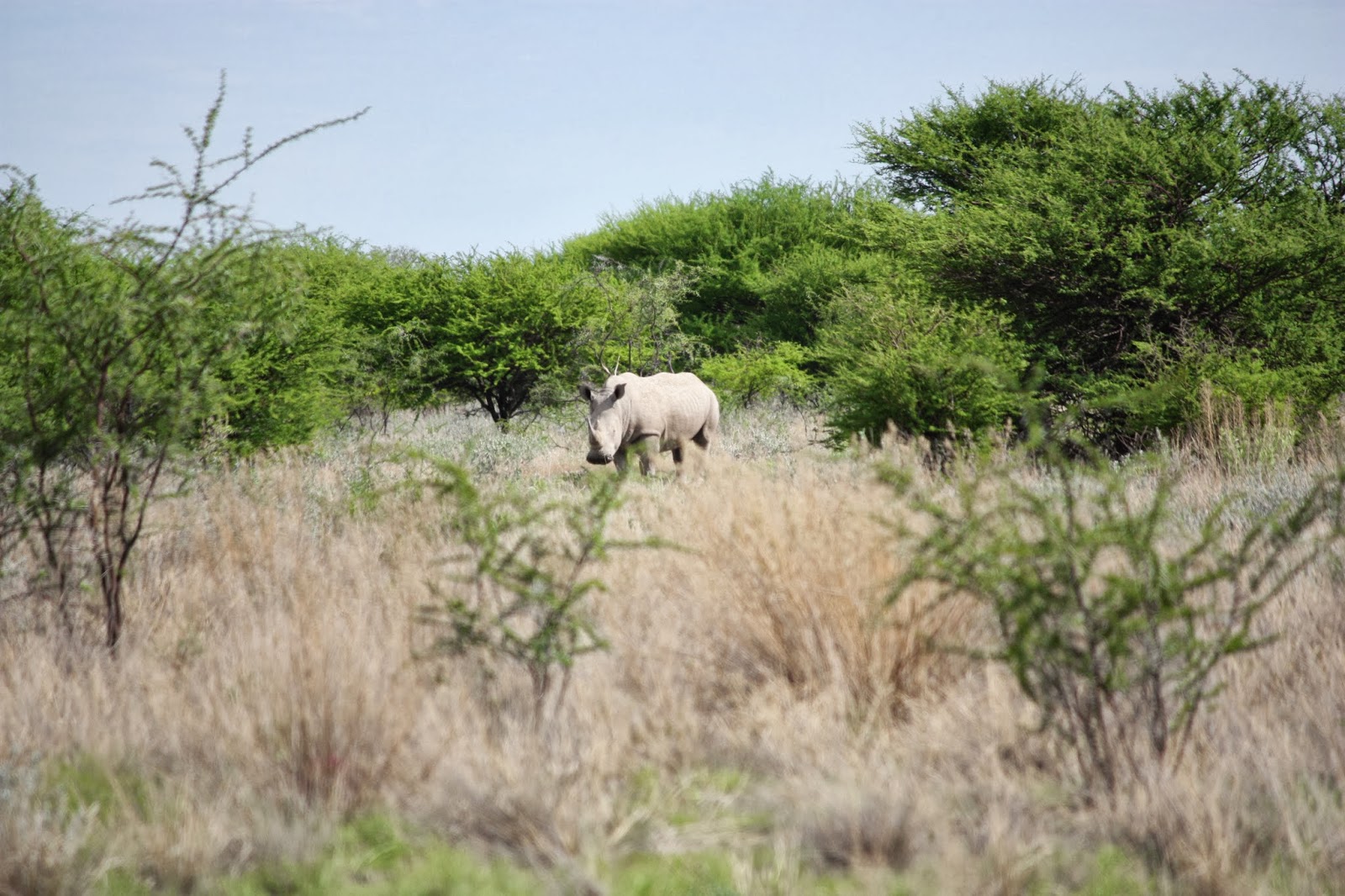
Our first sighting of a white rhino!  White rhinos are larger than black rhinos and have an extra fold of skin under their arms.  They are very big animals.

Turn and face.  These guys want to make sure you know that they know that you are there.

Rhino rears.

Yes, this was our third rhino spotting of the day.  Sorry we can't hand over binoculars, but if you zoom way in you can see a large brown-gray lump in the middle of the picture.  It is resting in the shade of the tree.


The bakkie (Afrikaans for pickup) and the sky.

Saturday, January 4, 2014

day 1: etosha national park (namibia)

Here comes part one of a long series of blog posts full of pictures of our road trip north to Namibia! We had an absolutely amazing time, and can't wait to share the whole trip. We drove from Windhoek (after a short flight from Cape Town) north to Etosha National Park, where we spent three nights. We then went to a region called Damaraland, west of Etosha, between the park and the coast, for two nights. Then on to the Skeleton Coast for one night in the bustling vacation town of Swakopmund, and back into the desert for three nights in the Naukluft mountains to do some hiking. We finished the trip with two nights in Sesriem to see the sand dunes at Sossussvlei. We got to watch the sun rise on Christmas morning over the dunes.

More on that later! Here's a description of what we did and what we saw on our first day.

We flew to Windhoek, the capital, picked up our rental car (a "4x4" - pickup with 4-wheel drive, equipped with a rooftop tent and camping gear) and braved the shopping mall in the center of town on the last Saturday morning before Christmas to buy groceries before heading up the road to Etosha.

We drove north on the B1, one of only a handful of paved roads in the country, to Okakuejo (oh-kah-kwey-yo), a camp and lodge just inside the southeastern gate of Etosha National Park. We had pretty high expectations for our Etosha trip - we'd heard it is in the same range of parks as Kruger National Park - and we weren't disappointed.

The park is oriented around a giant (mostly) dry lake bed called the Etosha Pan. Once a year (or every few years) this pan fills with a few inches of water, and giant flocks of flamingos come to visit. We didn't see that, although we were there during rainy season, but we did see lots of heat shimmers that looked like water! And tons of other wildlife.

We got into the park and were pleasantly surprised to see a bull (male) elephant near the side of the road. After setting up camp and cooking dinner, we spent about two hours at the floodlit water hole where we saw lots of action: jackal, owl, two male lions, another bull elephant, and a black rhinoceros. 

The next morning, we got up and took our first game drive. We were so excited to see the many grazing animals and some bigger guys too.
We had our first big animal sighting (aside from 5 warthogs, goats and cows on the highway, and a red hartebeest and two giraffe on the road from the airport) just a few minutes after we got into the park! A big bull (male) elephant with half a tusk missing.


After watching a jackal chase an owl for about 15 minutes at the water hole, we were thrilled to see this guy and his friend come in, drink, and play for about ten minutes. If you can't quite make him out yet, check the next picture.

Yep, a male lion. Young males sometimes roam around together. We watched them lay around at the water hole, then get up and slowly stalk away. One turned and let out a low roar, which was truly amazing to hear.

The excitement at the waterhole continued that night: the two lions moved off with a roar (literally, so cool!) and a minute or two later, this guy moved in. Our second bull elephant!


And THEN we saw this guy! A black rhino! Really. It was a big night.


The elephant moves off under the full moon.

We set off on our morning game drive the next day and saw giraffe barely out of the gate.

A jackal's den! We counted four pups. Can you pick out this one?

Herds of springbok (the namesake of South Africa's rugby team) grazed on this flat landscape.

Tuesday, December 10, 2013

nelson mandela memorial service (as viewed from cape town)

You've probably heard about this memorial service on the local news. It was certainly the talk of the town here in Cape Town yesterday. Nelson Mandela's official memorial service was held in Johannesburg, at a soccer stadium near the township of Soweto (where Nelson Mandela lived in the 1950s with his wife Winnie).

Jim and other teachers streamed audio from the event while at school; I was in Cape Town, and stopped at the Grand Parade outside City Hall to watch a few of the speeches on the big screens set up for crowds there. The day was not declared a national holiday, which may have had an impact on crowds - they seemed to be smaller than expected in Cape Town.


I was interested to hear who was popular with the crowds, both in the stadium and on the street in Cape Town. UN Secretary-General Ban Ki-moon received cheers as he began his speech from the Cape Town crowd, who were much more respectful than the audience at the stadium (who continued to sing songs during almost all the speeches). Former President Bill Clinton also received applause. Images of Zimbabwe's long-time president Robert Mugabe on the big screen were also big hit (Mugabe is controversial for his human rights abuses, nearly 30-year grip on power, devestating impact on Zimbabwe's economy, and policies of "indigenisation" - a law passed in 2008 that gives black Zimbabweans the right to take over and control many foreign owned companies in Zimbabwe). Former President George W. Bush (who Mandela had criticized over the invasion of Iraq) got a few boos, as did current South African President Jacob Zuma (Zuma's were much more intense, and likely stem from the ongoing and recent accusations of corruption as well as general dissatisfaction with poverty, unemployment and crime in SA, especially in black communities).

But the biggest applause by far went to President Obama and First Lady Michelle Obama. Every time they were captured on camera, the crowd erupted at the stadium, and I heard loud applause in the Grand Parade in Cape Town. I was back in the car by the time Obama spoke, but it was clear that his speech was well-received (to say the least) - it got a standing ovation.  I was awed by his speech (as were the radio commentators I listened to), and appreciated that he used the moment to call listeners to action and not just reflection. Here's a link to the audio and the prepared text, in case you missed it.

Rest in peace, Nelson Rolihlahla Mandela. 


Sunday, December 8, 2013

bees shut down the middle school


 Better HD videos will be loaded later--internet here is a little slower than the states.

Bees Swarm Middle School Courtyard

Moving bees into the box

Queen Bee Walks into box

mandela movie and new political organization

After watching "Mandela:  Long Walk to Freedom" last night Jennifer and I were blown away by how accurate and vivid the imagery of South Africa and the race relations was portrayed.  The violence and struggle for political freedom has changed forms, but the sociopolitical landscape remains largely unchanged since Mandela was elected.  The pervasive attitude towards race has changed much, but there are still many ignorant people of all races.  In addition, economic conditions for white, black, and people of color have not changed much.  The poorest settlements are nearly 100% black and most do not have any running water.  Currently, there are large protests taking place to improve sanitation in the settlements.  In Khayelitsha there are currently ten households sharing a single porto-potty.  It is incredibly sad to drive by these settlements on our way to and from great adventures in South Africa.

One important realization that Jennifer and I have come to is that the settlements are a constructed reality--that they do not have to exist.  They were created in a system that was designed to make living situations so horrible that black Africans would move into the interior of South Africa.  Of course the interior of South Africa is not arable and there are no chances for employment--besides the mines of course, which have a continual supply of very cheap labor.  So, after twenty years of political freedom there has been little progress in addressing rampant poverty in the settlements. 

An interesting movement to watch is the Economic Freedom Fighters (EFF) who are currently vying for a majority vote in the Cape Flats.  The EFF stands in support of gaining more land for settlement and improving sanitary conditions within the settlements.  The EFF is running as opposition to the African National Congress (ANC), which was Nelson Mandela's party.  Corruption within the ANC and opposition to leftist proposals, the ANC is leans way left and can identify as communist, by the Democratic Alliance (DA) have thwarted much of the progress.  In other words, change is possible, but the political gridlock and corruption prevent progress from occurring.  For this reason I think the introduction of a third party and truly the second black party in South Africa will prove very interesting to watch.  The DA is the white party within South Africa and leans right. 

Here is the website for the EFF:  http://www.economicfreedomfighters.org/

http://www.youtube.com/watch?v=a7SKQZYdZ1c

Despite Malema's beret we hope he continues nonviolent protests, such as the Poo Protests, in which human faeces is dumped in front of government buildings, on major highways, and at the international airport, in an effort to draw attention to the horrid sanitary conditions within the settlements.

Hopefully positive change will continue--economic repression is still rife within South Africa--yet I believe these protests would never have been allowed to happen twenty years ago.  Democracy isn't always pretty, but it does mean progress towards a mutual understanding.

This is my first socially focused blog post, but I think it comes at an apt time as we reflect on the socioeconomic landscape that was changed so much for the good by Mandela.

Friday, November 22, 2013

township visit (khayelitsha and gugulethu, cape town)


This week, I had the opportunity to ride along on a visit to a non-profit and a couple of schools in two of the biggest townships in Cape Town. Jane, a woman who gives time and money to a variety of causes in and around Cape Town, took me along with her for the afternoon as she checked up on friends and projects she supports.

First, we visited the Khayelitsha office of TAC, the Treatment Action Campaign, a group that works to educate people on AIDS and HIV. They manage volunteers (often unemployed youth) who go door-to-door in their neighborhoods and settlements, telling people about how HIV is contracted, why condoms are important, and resources available for treatment. Jane and I met with her friend Mandla Majola, the District Coordinator of the Khayelitsha branch.

Mandla spoke to me about the main problems facing Khayelitsha: it has between 750,000 and 1 million residents, but does not have proper sanitation or housing services. Some areas do not have roads, so are nearly impossible to reach with emergency health and police services. Unemployment is around 40% (as evidenced by the number of people walking around town at mid-day). Most homes are made of wood or tin, and don't have toilets - an average of 10 homes shares one toilet (and those are often actually just porta-potties). Finally, crime, especially rape and abuse, are too common. His biggest concern, however, was the increasing usage of "tic," or methamphetamine, especially among teenagers in the settlements.
I didn't have a camera with me this week, so here's a Google image of Khayelitsha that is pretty representative of what you see from the road.
I asked him what jobs people are looking to get: most people are unskilled, and really can only work as "domestics" (maids or housekeepers) or laborers - gardeners or on construction crews. Many people have moved to Cape Town from the Eastern Cape, an area with few large cities and even fewer jobs than Cape Town.

Mandla and I at TAC offices.
I can't say the conversation was uplifting, but it was a good dose of reality for someone who's been spending most of her time in South Africa hiking or tasting wine (as you can tell by the pictures on this blog).

TAC offices in Khayelitsha
Next, we went to two primary (elementary) schools. At the first, the John Parma School in Nyanga, we looked at a classroom that Gustavus Adolphus College in St. Peter, MN has donated supplies to (via Jane, who is from Minnesota). At the second, The Lehlononolo School in Gugulethu, we saw a garden that Jane's non-profit has funded in an attempt to improve the  diets of children at the school. I did see a computer lab with about 20 computers, each probably 15 years old (and only some working). We spoke with some teachers, who told us about their class sizes: 37 in one, 45 in another. (Something of a far cry from the private school where Jim is teaching; he has one class with 9 students). Parents must pay for school uniforms to attend these government schools, but they are the least expensive option; wealthier families can pay for a "C Level" school, with moderate fees (a few thousand USD per year), or a private school, with fees ranging from $8,000 USD on up.

At The Lehlononolo School's courtyard. Lehlononolo means "blessing" in Sotho. Pictured are Lydia, her son Teo in his school uniform, the school's acting principle, Jane, two teachers, and me.
Jane introduced me to Lydia and her son Teo, both living with HIV, and I heard a bit about their health problems. Lydia and Teo both get health services from the national healthcare system; they are both on antiretroviral drugs (ARVs) and have lived much longer than Jane ever expected they would. His suppressed immune system means that Teo has had tuberculosis numerous times in his 10 years, and has had to have various surgeries to manage other health problems.

Finally, we stopped to see Mary Sili, Jane's friend since 2003. Mary lived in Gugulethu, in a house she's been in since she and her husband were moved from their first home in Simonstown (on the Cape Peninsula) in the 1950s. Mary's home was lovely. They had a comfortable leather couch, a big screen television, large framed pictures of their six grandchildren on the walls (all the children of their son, and mostly living with their respective mothers), an indoor bathroom, a new dining room table, and a covered car port. Mary and her husband had both worked for most of their lives, and had been retired for a few years (Mary is 72 years old).

Me and Mary in her home.
 Mary had a unique story about apartheid: her mother was "Coloured" (South African classification for someone who is mixed race or often of Indian descent) and her father was "Black" (meaning African). Under apartheid, Coloureds had more privileges than Blacks. (In modern-day South Africa, we meet lots of people who refer to themselves as colored, and we see that many coloreds still have better education, homes and jobs than most blacks). Mary and her sister were raised in a convent after their mother died (Mary was 12, and her sister was 9 at the time). When it came time for them to leave their sheltered lives at the convent, they had to get their work papers in order. Mary went to the government office to get hers, and she was classified as "Black." Her sister, however, was classified as "Coloured." Mary showed me a picture of her and her sister; they looked nearly like fraternal twins.  

I found Mary's friendliness and positivity really appealing after a day of feeling a bit on edge. She told a few stories about other people in her life - a girl who was being sexually abused by her stepfather in the area, who Mary and her husband helped to get out of the home and into foster care (and eventually graduate from university). But throughout, she seemed at peace with the hardships that had come her family's way, and happy to be alive and relatively well with her husband, son and a granddaughter to care for.

As Jim and I see more of southern Africa (outside of the beautiful tourist destinations), we'll continue to write about what we see. If you're interested in reading about apartheid, I'm in the middle of My Traitor's Heart, by Rian Malan. It's eye-opening, and comes from an interesting perspective: a liberal Afrikaner, who tries to dissect his "clan" and their worldview. 

Wednesday, November 20, 2013

beach walk (kommetjie)

Last weekend was rainy! It started pouring on Friday afternoon while I was out on a walk, and didn't stop for about two days.

We spent Saturday in Stellenbosch with our roommate Patrick, who ran a half marathon. Jim and I had gone out for dinner the night before and found it tough to wake up at 6 to get to the finish line by 7:30, so all three of us were ready to reward ourselves with a big breakfast after the race :) At least Jim and I could say we "went to" the marathon.

Sunday began clearing off by noon, so Jim and I decided to do a beach walk we'd read about in our new Cape Town hiking book.

We set off from Long Beach in Kommetjie (pronounced comma-key - "tjie" sounds like "key" in Afrikaans) and walked along the water, watching surfers in the water and dogs on the beach. As we got further up the beach, we started to see seals! We saw a few dead ones, actually, on the beach, but also some live ones in the water and coming up out of the water to warm up.

We walked past an African Oystercatcher colony as well as some flocks of flamingos.

The walk's turning point was a shipwreck which seems to have been salvaged and scrapped over time - currently a large boiler and some iron posts are all that's left, but you can still see the boat's general outline and length. It has been pretty buried in the sand.

We turned and walked back, wading through river outlets in a few points, and enjoyed watching surfers again before heading home.


Wednesday, November 6, 2013

gorgeous saturday! (camps bay, cape town)

Last Saturday was a really, really, really beautiful day, and Jim and I made the most of it! We got up and made a big breakfast, and then hit the road to find a great hike. We had heard about walks beginning in Camp's Bay (a neighborhood on the water just over the hill from the center of Cape Town) and heading up Table Mountain from the Atlantic Ocean side. After driving around for half an hour or so :) we wound our way up the hill to the start of trail. We chose one path up the mountain and set off; we thought we'd hike for three hours or so and then head to the beach! (Camp's Bay also has a great beach that is very popular with tourists, which we kind of like right now because we aren't the only sometimes-confused white people wandering around! "Other targets," as Jim says).

Well, all roads up Table Mountain seem to be steep, and this one is no exception. We huffed and puffed for about two hours, clambering over boulders and up a very steep, very long (but luckily not very full) waterfall, before reaching a beautiful overlook about 200 feet below the top of the mountain, and decided to take a break, which we spent staring at the turquoise blue waters of the beach below us. Surprise, surprise, our "break" turned into our turning point. We gave up on the summit and headed back down. But we did make it to the beach for the rest of the day.

After "sundowners" (drinks at sunset) with two other teachers from AISCT, Jim caught some beautiful shots of Camps Bay on our drive back along the coast.

Starting the hike! Looking up at the "twelve apostles", the name of the twelve large outcroppings that stretch along the coast between Table Mountain and Hout Bay. We climbed up between the third and fourth ones from the left (yes it was steep!)


Already a pretty view back toward the beach, with Lion's Head on the right. Cape Town city center is off to the right, over the other side of the hill.

Already hot! Remind us to start hikes before 11am next time.

Taking a rest under a shady outcropping, with beautiful views.

Walking along a ledge, winding our way over to where we'll start to climb in earnest.


The waterfall we climbed up. Yes, it was really steep!!

The trail drops off behind these bushes; the views were beautiful the whole way!

Jim at our "peak"!

Mm, that beach behind my head looks nice.

Sweating our way down.

Table Mountain Quartzite, what Table Mountain is made of, has properties that make it break off and erode at right angles. That's why the hills look like they are full of square rocks, and have such sheer faces.

Looking back toward Camps Bay just after sunset, with the twelve apostles on the right.

Looking out toward sunset.